

Wednesday January, 22 had all the potential of being a rainy day. We were ready and armed with passes that gave us access to four of the main historical churches in the city. Our first stop was an interesting combination of ancient castle fortress and two churches. The ruin of the ancient Castello do Tavira occupies the highest geographical position in the old town and was a defence for the ancient fishing town against pirates and other invaders. The castle dates from the 11th century when the Algarve and whats now known as Portugal was under Arab rule. Tavira was conquered by Christian crusaders in 1242 and the castle fortification was expanded by King Dinis in 1294. The ruin of that fortification is what we explored on Wednesday.


The Church of Saint Maria of the Castle was our immediate next stop. It’s the church with the landmark bell and clock tower that can be seen from man points in the town and at a distance.


The interior architecture spans many centuries as does the exterior.


The next stop in our church crawl was the adjacent Church of Santiago or Saint James of the Sword. It’s a medieval building from the 13th century that may have been built on top of a Muslim building. It was damaged in the earthquake of 1755 as were many buildings in Portugal.


On the way to our next stop, the Church of the Misericordia, we encountered an archeological excavation site that showed remnants of building dating back to the time of the Phoenicians.


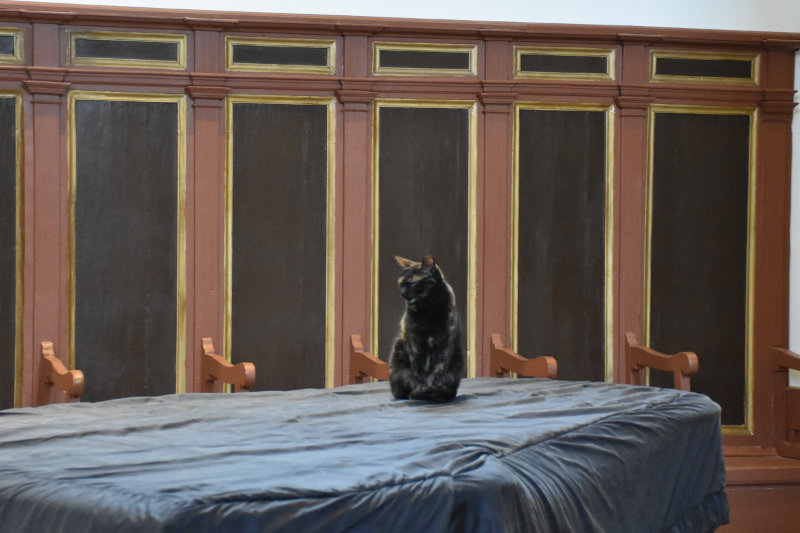
The interior walls Misericordia Church, the Church of Mercies, are lined with blue and white tile depictions of the Divine Mercies. It’s also the church where a lovely friendly cat stepped into the picture. He was elegantly perched on the top of a grand piano patiently posing for whoever wanted to photograph him. We sat down for a rest and he ambled over to join us and later followed us out to the gift shop where he or she strategically disappeared under a draped display table.


The final church on the list was the one that hasn’t been open whenever I’ve been in Tavira in the past. It’s on the opposite side of the river from where we were staying not far from the Roman Bridge.


 Five Feet, Nine Inches Above Ground
Leave a comment